Publications
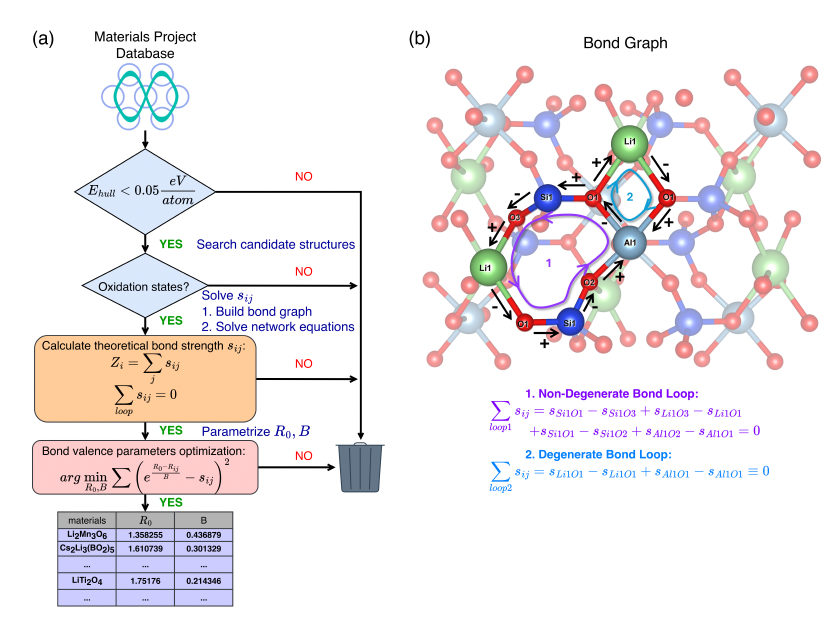
Lithium-Pyroxene Formation Threshold Predicted by Data-Driven Global Bond Valence
I was part of the work where our research shows that by fitting bond valence parameters for each structure individually, you can recover formation energy trends using global instability index accurately.
Read Paper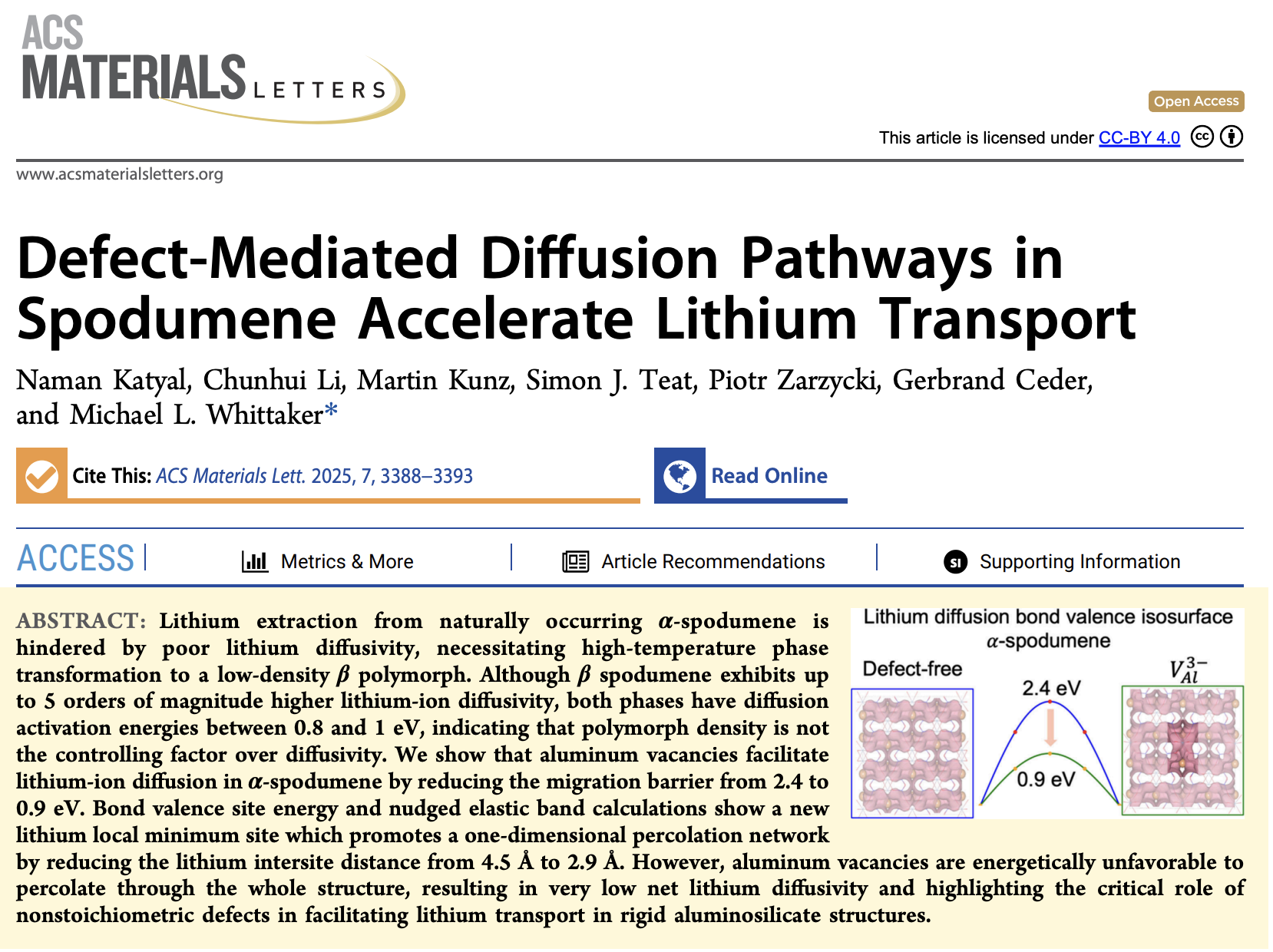
Defect-Mediated Diffusion Pathways in Spodumene Accelerate Lithium Transport
I was part of the work where our research shows that tiny defects,specifically missing aluminum atoms,create new pathways in spodumene, drastically reducing the energy needed to move lithium ions. This discovery is key to developing more efficient and less energy-intensive methods for lithium extraction.
Read Paper
Fe (III) dihydroxybenzoquinone-based metal organic framework for sodium battery cathodes: Properties, charge-discharge kinetics and redox reaction mechanisms
I was part of this research where we investigated sodiation profile in MOF based sodium cathode material involving organic redox. The suite of computational analysis involve convex energy hull diagrams, Raman spectroscopy modeling and sodiation voltage profile.
Read Paper
One-Step Pyrolysis Construction of Bimetallic Atom-Cluster Sites for Boosting Bifunctional Catalytic Activity in Zn-Air Batteries
I was part of this research where we've developed a simple, one-step method to mass-produce powerful bimetallic catalysts by anchoring iron and nickel atoms onto activated carbon. Thanks to the synergy between the metals, these catalysts enabled a zinc-air battery to achieve a remarkable stability of over 1000 hours.
Read Paper
Urea‐Modified Ternary Aqueous Electrolyte With Tuned Intermolecular Interactions and Confined Water Activity for High‐Stability and High‐Voltage Zinc‐Ion Batteries
I was part of this research where we developed a low-cost electrolyte by adding urea to a water-based zinc-ion battery, which "locks up" free water molecules to suppress harmful side reactions. This simple approach significantly expands the battery's stable voltage window and enables long-lasting, high-performance energy storage.
Read Paper
Atom-centered machine-learning force field package
I was part of this research where we developed PyAMFF, a user-friendly, Python-based package that uses an atom-centered neural network to construct fast and accurate machine-learning force fields. The package is highly efficient and scalable due to its integrated Fortran modules and is designed to interface with other simulation software like EON and ASE for advanced applications.
Read Paper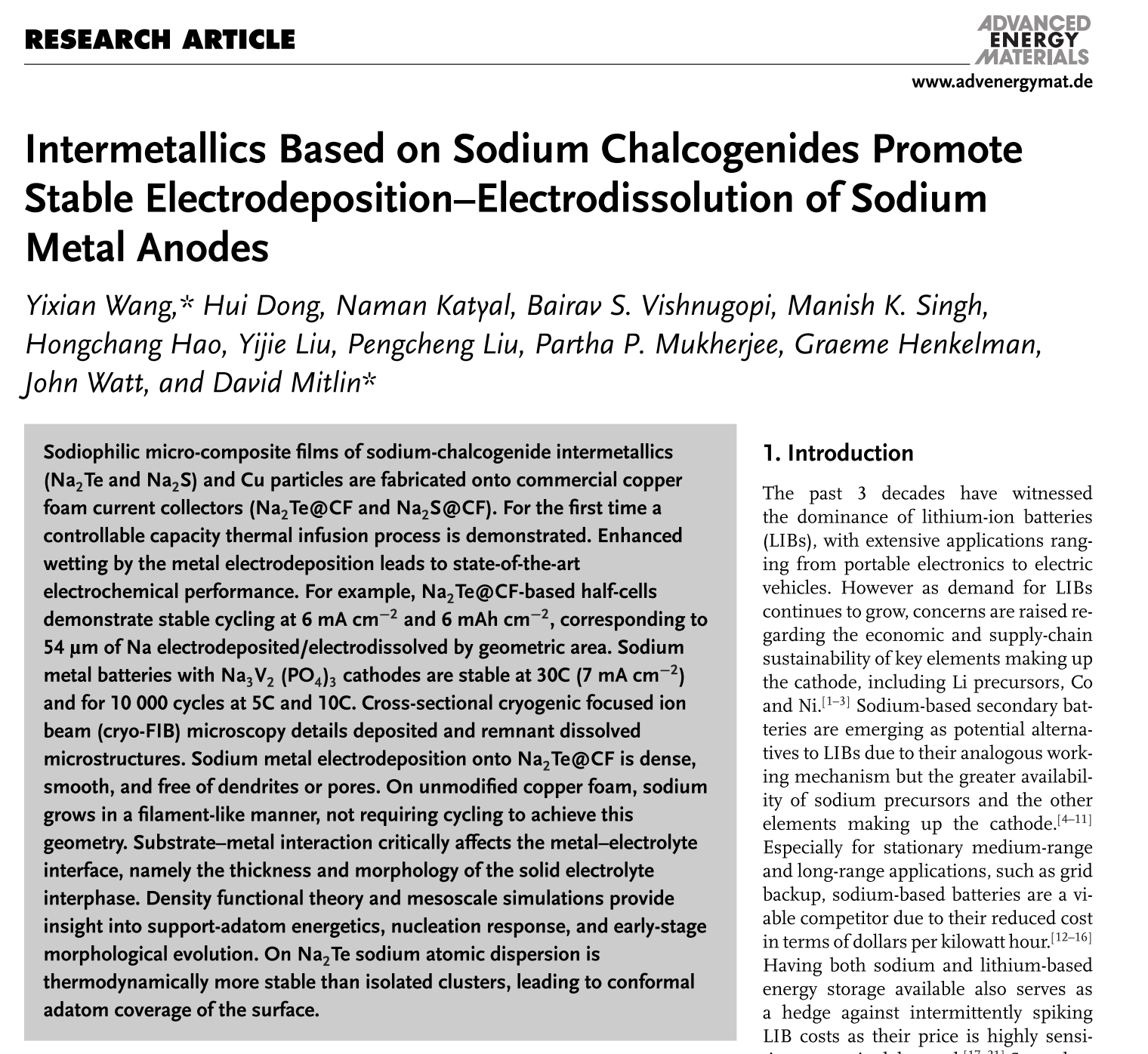
Intermetallics Based on Sodium Chalcogenides Promote Stable Electrodeposition–Electrodissolution of Sodium Metal Anodes
I was part of this research where sodiophilic micro-composite films of sodium-chalcogenides (Na₂Te and Na₂S) were fabricated on copper foam current collectors to guide sodium metal electrodeposition. This new substrate enables dendrite-free sodium growth and creates a stable solid-electrolyte interphase, leading to sodium metal batteries with state-of-the-art stability and high-rate performance.
Read Paper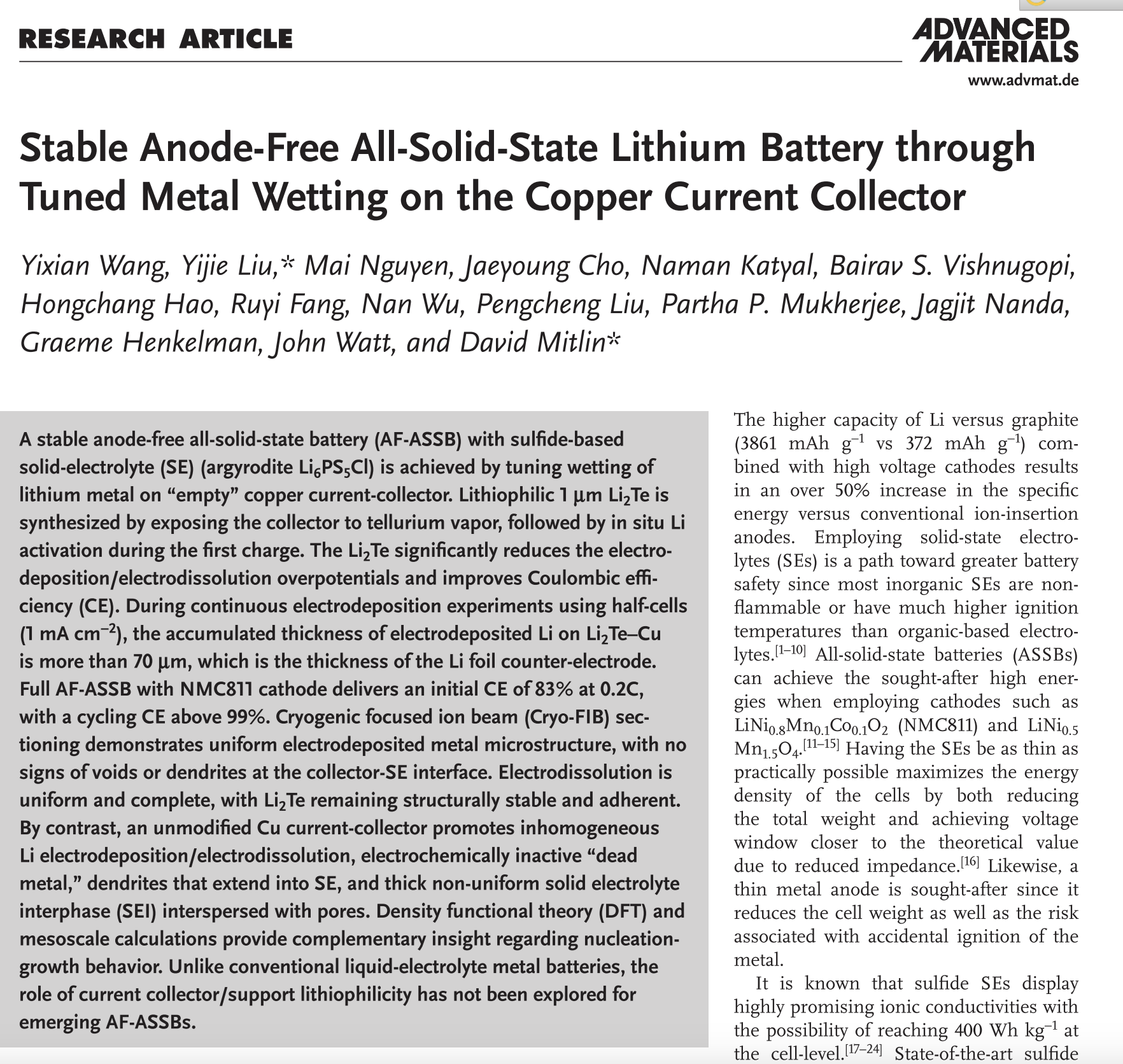
Stable Anode-Free All-Solid-State Lithium Battery through Tuned Metal Wetting on the Copper Current Collector
I was part of this research where a stable anode-free all-solid-state battery was developed by modifying the copper current collector with a thin, lithiophilic layer of lithium telluride (Li₂Te). This engineered surface promotes uniform, dendrite-free lithium metal deposition, which dramatically improves the battery's Coulombic efficiency and cycling stability compared to standard collectors.
Read Paper
Modulation of CO2 adsorption thermodynamics and selectivity in alkali-carbonate activated N-rich porous carbons
I was part of this research where we analyzed how the choice of activating alkali cations (lithium, sodium, or potassium) during synthesis impacts the properties of nitrogen-rich activated carbons. It demonstrates that the specific cation used significantly influences the material's nitrogen content, porosity, and surface area, which in turn allows for tuning its thermodynamic efficiency and selectivity for CO₂ capture.
Read Paper